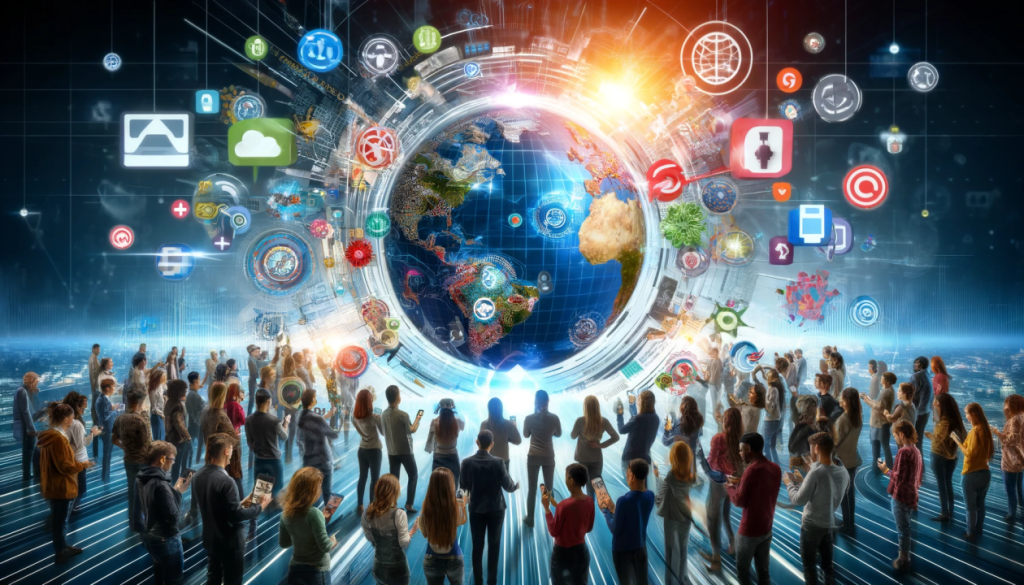
In today’s day and age technology has become a part of humanity; it has become something that defines who we are. Most of the time, digital media is said to be positive, a space that connects us, gives everyone a voice, and makes information convenient to access. Social media is known to give a sense of freedom and to open opportunities for users. Although when you dig deeper, digital media is much less empowering than we think. Instead, it often strengthens the same power structures that are already existing in society. In the end, big tech companies control everything we do online: what we see, how we communicate, and even how we present ourselves.
By looking at ideas like the “Black Mirror” concept, Sherry Turkle’s view on identity, and Andrew Keen’s chapter called “Epic Fail,” it becomes clear to me that digital media doesn’t only connect us, it also heavily controls us. It has become something that shapes how we see ourselves and it also gives even more power to the companies than to the people who are using the platforms.
While researching for this paper, I focused on algorithms because they are one of the main ways digital media creates such an imbalance. Algorithms decide what shows up on our feeds, what videos we watch next, and what news we see. People only think about this sometimes, I know for myself I rarely gave it a thought because it feels like there is nothing we can do, so why not just continue to scroll? But these systems are not neutral, they are created by companies that have their own intentions and their own goals. All these companies care about is promoting content that simply grabs your intentions but is not necessarily true or meaningful.
Andrew Keen made some good arguments, one of them being that the internet has failed to achieve its promise: creating an equal space. Instead, it has just made some companies way to powerful. We might not think our online life is being controlled but these major companies control huge amounts of our data and have a role in how humans think and react. There is a hidden power system where corporations have more of an influence than us users. We never had control.
This concept is highlighted in Black Mirror’s episode “Nosedive”. Every episode of black mirror is featured in a different world, all symbolizing this earth that we live on. In the episode “Nosedive,” they live in a world where people rate each other after every single interaction. These ratings decide your social status, what job you work, and your overall lifestyle. My first thought was that this was extreme, but then I got to thinking and realized this is not much different from what happens in real life. People truly care about likes, comments, followers, and these numbers affects how people see us and how we see ourselves.
This follows the idea of self-surveillance. People will change the way they act because they know they are being watched and judged. Most people are forced to follow the rules, in this case people choose to follow the rules to “fit in”. In “Nosedive,” the main character becomes so obsessed with having a high rating that she acts fake and hides her true self to be accepted by society. This is an example of how power can work without any direct control, we are the vessel of our beings, we control ourselves.
Circling back to Sherry Turkle, she talks about something very close when she mentions our identity online. She states that people create different versions of themselves online. We choose carefully what to post, depending on how we look and what we say. Us users create versions of ourselves that may not even be true. Instead of being genuine and authentic, we are performing for an audience.
People tend to act certain ways to control how they are seen, which is called self-presentation. Our online presence makes this even stronger because everything is visible and everything is permanent. Our posts can be commented on, liked, shared, and even judged instantly. Because of this, users feel the need to appear perfect. This is a problem because it puts the belief in people’s heads that our identity is meant to be measured and judged. Just like the episode “Nosedive,” likes, comments, and followers become a way to rank people, making a system where some voices are more valued than others. Usually, people with a higher follower count have more of an influence which is another way power is shown in the digital world.
When we are online, we are constantly generating data, through creating content and just simply interacting online. Our data is collected and used for advertising and for higher power profit. This is known as surveillance capitalism. In the chapter “Epic Fail,” Keen explains how the internet is meant to empower us, but in contrast has turned it into something to be bought or sold. We think we are using these platforms for free, but that is not the case, we are paying with our time, and our data. This shows the imbalance between the users and the companies in control.
I have watched every episode of Black Mirror and the episode that correlates with this theme of loss of control would “The Entire History of You.” In this episode people can replay their own memories whenever they choose. At first, this sounds awesome, but it quickly becomes negative. The main character falls obsessed with watching his past, attempting to find issues in his relationship. Instead of making a positive change in his life, this technology makes him very anxious. This symbolizes that more information doesn’t always mean more power. The ability to see the past became a form of control over one’s thoughts, trapping people instead of freeing them.
Another topic that ties into digital media would be our privacy. These internet platforms encourage us to share personal stuff about our lives. We feel comfortable posting pictures, locations, and our thoughts and opinions. This has become nothing but normal to do, but this does make people more vulnerable. Like I have already mentioned, once something is online it can be tracked, stored, and even used against us. In the episode of Black Mirror “Shut Up and Dance” the main character is black mailed using private information that was taken from his computer. He is forced to listen and follow orders because he is afraid of being exposed. This episode showed me how dangerous it is to have personal information online, and how easy it is for personal to turn public. This stuff happens in real life all the time: data breaches and hacking.
Sherry Turkle mentions how communication online affects relationships. She states that people are “alone together.” This implicates that people are always connected even when we aren’t communicating. Opposed to deep conversations, we now send quick messages. This reduces the true power of human interactions. Strong relationships are extremely important in creating positive communities and in challenging systems in power. When people are isolated or even distracted, we are less likely to question the people in power. Digital media weakens these connections which makes it easier these systems to stay where they are: in control.
Now I want to talk about how important digital design is. Platforms are literally made to keep us users online. Features including likes, notifications, and the endless ability to scroll are designed to be addicting. The more time we spend online, the more money these platforms are making. Our behaviour towards digital media is being influenced by the design choices. This is shown as an example in the Black Mirror episode “Fifteen Million Meritt,” where people live in a world where everything is revolved around screens. Points are earned by riding bikes which are then spent on entertainment. The main character then decides to speak out, which leads to his anger being turned into something for others to be entertained by. Keen rises a connecting argument that digital media absorbs criticism to turn it into content. Even if we tried to resist, we will somehow still be a part of this system. This makes it hard to get out, or to create a change.
As thoroughly talked about, digital media has many issues, but with that it is important to also be aware of the potential. Socials can and does give people a voice, it does spread valuable information fast and worldwide, and it does connect people from different cultures. With that being said, these benefits do not come close to cancelling out the power structures that live among us. To activate a better online space, we need to be more aware of how these systems actually work. The one thing about awareness is that it is curative. This includes understanding algorithms, protecting personal information, and being careful with what we interact with online. This also means getting out into nature, into the real world and reconnecting to life, the real one.
In conclusion, technology isn’t simply a tool to talk to our friends but a system that has shaped power, relationships, and identity. Observed through algorithms, platform design, and surveillance, digital media is benefiting the corporations more than the users themselves. Through my examples using the famous tv show Black Mirror, Sherry Turkle’s article “Who Am We,” and Andrew Keens chapter “Epic Fail,” I have identified that technology is creating new forms of control while making it all seem wanted or even needed. By thinking about these issues and being aware we can start to genuinely question the platforms we sub consciously use every single day. Online is a very powerful place that hold a strong force, but it should never define us or have a say in how we connect to mother earth. Take the first step, understand the effects digital media has on us and begin using it in a more truthful meaningful way.
 emintheclouds